Turning Leaves 17
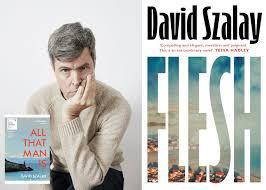
Flesh by David Szalay (soh-loy)
Published 2025
The book is, as the name indicates, all about flesh, human flesh and thus there is a prominence of sex, love and wealth in it. This book definitely earns a ‘For Adults’ certificate. This book has been awarded the 2025 Booker Prize.
The story begins in Hungary, where the protagonist, Istvan, grows up, living with his mother but experiencing sexual pleasures with an older woman who lives next door and whose husband he kills accidentally. He serves a jail sentence for this. After he finishes his jail term, he joins the army as he is not able to get a job. He serves with distinction in Kuwait and Iraq. On his return, he works in a winery but has to undergo therapy due to his traumatic army experience which affects his work. He has violent bouts in which he hurts himself physically. There is an abrupt change in setting and he is in London working as a security guard at a pole dancing place in Soho. One early dawn while returning home from work he rescues a man from being murdered. He turns out to be the wealthy owner of a private security agency. Istvan is groomed, trained and is given a job. There is no looking back for Istvan. He becomes a member of the wealthy 1% of London. He becomes Mr and Mrs Nyman’s driver. Mr Nyman dies, he marries Mrs Nyman, uses serious money to set up property development projects and to enjoy a privileged life. But unfortunately, the money belongs to Mr Nyman’s son who is a minor who watches from the sidelines. His own son, Jacob, dies and his wife remains on a ventilator after a car accident. Mr Nyman’s son, Thomas, becomes a drug addict. He sues Istvan when he inherits his money from the trust fund. Istvan returns to Hungary a pauper. He works as a security guard at the Media Markt. His affair breaks up. His mother dies. He inherits her flat and starts living alone.
The style of writing is cryptic making it easy reading for the modern reader. There are hardly any paragraphs. Mostly conversations and short descriptions are used. He has revolutionised how narration in novels can be done. His words are simple. The narrative is skilfully woven and is modern and contemporary in its content. However, life is dictated to by the flesh is the common thread running through the narrative. This book, has been awarded the 2025 Booker Prize. David Szalay’s book ‘All That Man Is’ was short listed for the Booker Prize in 2016. All his other books have won awards.
Turning Leaves 16
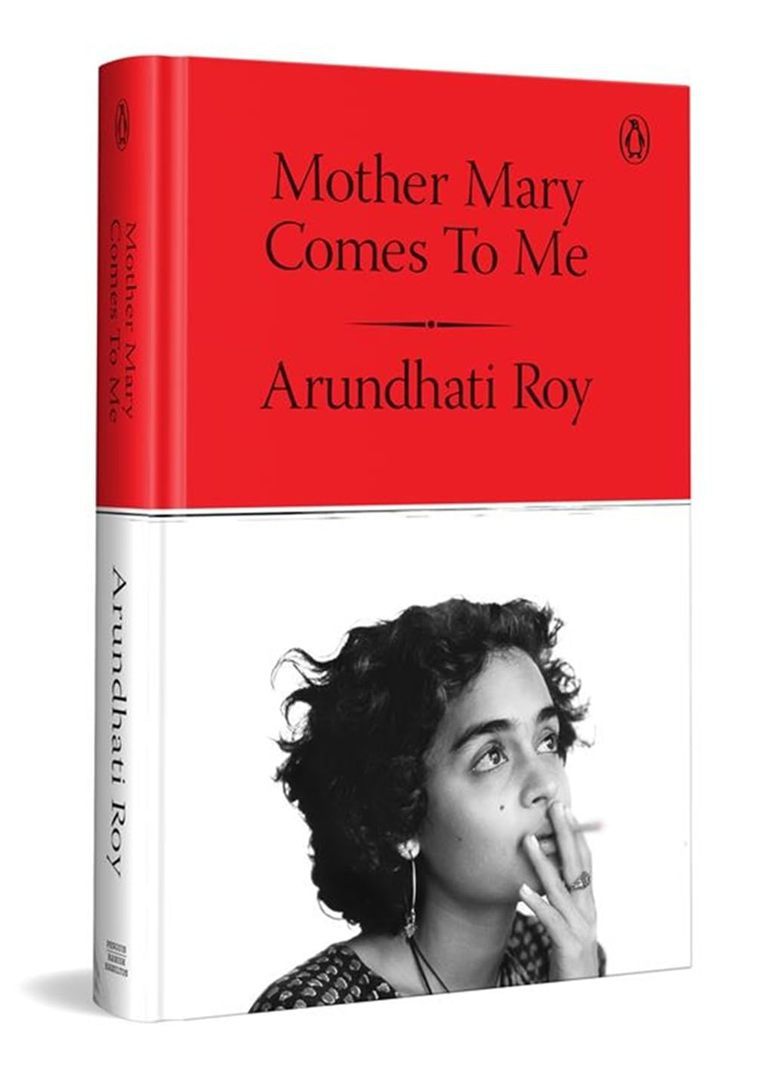
Mother Mary Comes to Me by Arundhati Roy
Published 2025
A memoir initiates a voyeuristic journey into another person’s life experiences. It educates and we learn from another’s experience at the same time. Arundhati Roy’s memoir, Mother Mary Comes to Me, does that too. It paints the picture of her life from her difficult childhood right through to the death of her mother in September 2022. Mary Roy was her mother and this book is a tribute to her. She was a teacher who set up a popular and well-attended school in the town of Kottayam in Kerala, India. She used innovative methods of teaching. At the same time, she fought for equal rights of inheritance for women. The Supreme Court was forced to change the Travancore Succession Act allowing women to have an equal share in their father’s property in Kerala due to her efforts. She became a powerful and well-respected figure in her town due to her exceptional intelligence, ruthlessness and indomitable spirit.
The book has been titled well, like all Roy’s books. It excites curiosity making the reader want to buy the book to find out why Mother Mary (one assumes The Immaculate) came to the author. The book makes for interesting reading especially for people of the author’s generation who can identify with the circumstances in India at that time even though the author has gone to great lengths to explain things to her readers who may not have lived through those times. These explanations have enhanced her style of ‘free writing’ which is lyrical, racy, readable and irreverent with a lot of tongue-in-cheek humor. There is a lot that one can identify with. The book is painfully truthful and the author mentions how much courage it has taken her to write this memoir. She writes about the adverse circumstances of her childhood and beyond. She describes her two works of fiction in detail. She records her remarkable work as an activist bringing to public attention the cruel and inhuman treatment of the adivasis of the Narmada Valley and the Kashmiris of the Kashmir Valley. Her work for the Naxalite guerrillas deep inside the Dandakaranya forest in Bastar, Central India, is detailed out. She doesn’t like being listed as a ‘write-activist’!
The book chronicles the early childhood of the author and her elder brother. Her early years were spent in a big bungalow in a tea garden in Assam where her father worked. But her mother decided to leave. She moved to Ooty and worked in a school there. She lived with her children in her father’s ‘holiday’ cottage. She observed British methods of teaching which she later implemented in her own school. However, she could not continue due to chronic ill health. She moved to her ancestral village in Kerala and moved in with her family to raise her young children. The author paints colorful pictures of the cosmopolitan family, her grandmother a talented concert violinist, her Rhodes scholar uncle with his Swedish wife and the owner of the house, her grandaunt, who had taught English in a college in Ceylon (Sri Lanka). Among them ‘the wild child with calloused feet’ lived. Her closest companion was ‘a striped palm squirrel’ who helped her cope with her rather difficult ‘ledge life’. Mary Roy/’Mrs. Roy’ subsequently moved out to build her school in the nearby town of Kottayam. She and her children lived in the school hostel with the students. Interesting details of the atrocities heaped on the author, including her pet dog being shot in the head, make for disturbing and heartbreaking reading. The author moved out and managed to graduate from the Delhi School of Planning and Architecture all on her own. She was reunited with her mother and brother after seven years. She metamorphosed into a documentary and small budget film actor. She went on to writing screenplays and won the National Award for Best Screenplay for the film, In which Annie gives it those ones. Later, a chance visitor to her home, the editor of Sunday, read her account of a failed film venture. This moved him to initiate recognition of her writing which catapulted her to becoming an iconic International Booker Prize winning author.
The author needs no introduction as she is an extremely prominent figure in the world of literature. Her fame has spread to most countries and her books have been translated into several languages. She is well respected by other renowned authors. She is wealthy now simply on the proceeds that she has earned from literature, as she mentions in the book. She is a prize-winning author who has revolutionized the way English is written. She has brought Indian English writing to the forefront of world literature even though she has lived in India all her life. This is no mean feat. It is a colossal achievement. For a young school student who did badly in English language and literature classes she has come a long way maybe because she always had a ‘writer’s heart’. Inspirational indeed!
Turning Leaves 15
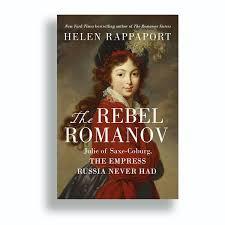
The Rebel Romanov by Helen Rappaport
Published 2025
This book is the story of the Grand Duchess of Russia, Anna Feodorovna. Her life is traced from 1781 – 1860. It is about the Princess Juliane Henriette Ulrike of the Saxe-Coburg duchy of central Germany who was married into the Romanov imperial family to save her father’s duchy from financial ruin. Incidentally it also tells the story of the entire Saxe-Coburg family who produced two European kings, the King of Belgium and the King of Portugal and Queen Victoria of Britain and her husband Prince Albert. Grand Duchess Julie was married to Grand Duke Konstantin, the younger grandson of the Russian Empress, Catherine the Great. Julie’s marriage brought Saxe-Coburg under the protective umbrella of the Russian Empire. It gave a huge boost to the military careers of the young men of the family leading to their marriages into the powerful houses of Europe. This initiated the rise of the Saxe-Coburgs leading to them being ‘upon thrones, next to thrones or behind thrones’ all over Europe. They were an exceedingly united family who were vastly fond of each other led by their ambitious but loving mother, Duchess Auguste.
The book opens with the long journey that, Princess Julie had to undertake with her mother and sisters from Coburg, in central Germany to St. Petersburg in Russia in horse-drawn carriages in the bitter cold. The book has several such descriptions as Grand Duchess Julie was to travel considerably throughout Europe for treatment of her chronic ill health and for visiting various family members and royal houses. These trips were hard and hazardous and proper accommodation along the way was hard to find. Descriptions of the conditions of living of the aristocracy of those days make for interesting reading. They wore expensive jewels and dresses, entertained lavishly, patronized music and the arts yet found it hard to find the finances to keep up this opulent way of life.
The well-known Romanovs ruled Russia for over 300 years. They amassed immense wealth. Catherine the Great was their greatest ruler second only to Peter the Great. The tragic execution of Tsar Nicholas II and his family have also etched the Romanovs into the imagination of the world. Catherine the Great chose Juliane of Saxe-Coburg-Saalfeld to be her grandson’s bride. She encouraged and supported Julie in her initial years at the Russian court which she joined at the tender age of 14. She often reprimanded and severely punished Konstantin for his cruelty and abusive behavior towards his young wife. It is said that the marriage would have worked out if only Empress Catherine had lived longer. Her mother-in-law, Maria Feodorovna schemed against her as she did not want her to produce offspring as she wanted her younger son, Nicholas, to become the Tsar. Julie suffered from chronic ill health throughout her life as she was impregnated with syphilis by her promiscuous husband. She was acutely unhappy in Russia even though she led a life of lavish luxury in huge, affluent palaces. All she wanted was to return to her home in Coburg.
She was able to leave because Tsar Alexander was extremely fond of her and admired her. She was sanctioned a holiday to Coburg. But she was never to return. She spent the next thirteen years travelling throughout Europe at first to try different cures for her chronic ill health. Then she searched for a place to settle down. She visited the royal courts of Prussia and her dear friend Queen Luise, divorced Empress Josephine, her brothers and sisters and the stunning high societies of Milan, Geneva and even Rome where she was much admired for her great beauty, her perfect figure, her clothes and jewels and her ready wit and intelligence.
She chose to settle down in Switzerland. This ‘unspoilt fairyland of breath-taking beauty had rustic charm, cleanliness and simplicity of manners’ far away from Napoleon’s advances for territorial acquisition. This was approved by the Tsar after a meeting with him in a pretty chateau in Southwest Poland. She bought a house on the outskirts of Bern and refurbished the interior indulging her taste for the Greco-Roman popular style. Her house was made fit to entertain the Tsar and members of the Russian imperial family of which she was a part, important Bern officials and foreign dignitaries. Political considerations had most probably paid a part in the Tsar’s approval of his sister-in-law’s permanent residence in this country of her choice as she could be the unofficial representative of the imperial family exerting a gentle influence on those who visited her in this independent and neutral European country. The house was located in the valley of River Aare surrounded by the Swiss mountains, the Oberland, the Eiger and the Jungfrau as backdrops. She named it ‘Elfenau’ or elves meadow. She extended the garden by buying the adjacent land and turning it into a beautiful English-style park. Still later, after more additions, it became a handsome estate. Her husband, Konstantine, came to visit her here as he wanted a reconciliation. Konstantin refused to become the Tsar on the death of Alexander I. He was appointed Viceroy of Poland, a position he held till his death. He did not change his ways and remained cruel, savage and as debauch as before.
Julie was maintained by the Russian treasury under Tsar Alexander and subsequent Tsars. She was given a handsome endowment to live on. She spent a lot on travel, entertainment and the upkeep of her large staff and estate. When her manager, Schiferli would point out that she needed to curtail her expenses, she refused to listen and often lost her temper with him. She was dearly loved by her niece, Queen Victoria of Great Britain and her consort, Prince Albert. Her portraits hang in British palaces even today. Her brother Leopold was fond of her and took an active interest in her security and wellbeing. She was close to her other two brothers and to her sisters especially Victoire, the mother of Empress Victoria.
Helen Rappaport specializes in the reign of Queen Victoria, late Imperial Russia and the Romanov family. She has done extensive research on Grand Duchess Julie. The book is like a research thesis on her. There are pictures of authentic portraits on the center spread of the book. The first few pages carry old maps of Germany and Russia. There are family trees of the House of Saxe-Coburg and the Romanovs of the Napoleonic Age. Several sources have been acknowledged by the author running into several pages of bibliography and there are footnotes on almost all pages of the novel. However, these do not distract from the reading of the pages. Rappaport has written several books. She is a freelance history writer. This book contains a lot of history of the Napoleonic Age yet Princess Julie’s story is readable and interesting. However, she doesn’t come through as a rebel, as the title suggests, but rather as a well-bred aristocratic lady, talented, clever and kind, a facsimile of high-born ladies of her time. She could not be the meek and dutiful wife as the degenerate savagery of her husband and the intrigues of the Russian court overwhelmed her and forced her to run away to safeguard her health, sanity and wellbeing. She was a woman of extraordinary courage who took charge of her own life. As we read, we sympathize with her and she appears more of a runaway than a rebel.
Turning Leaves 14
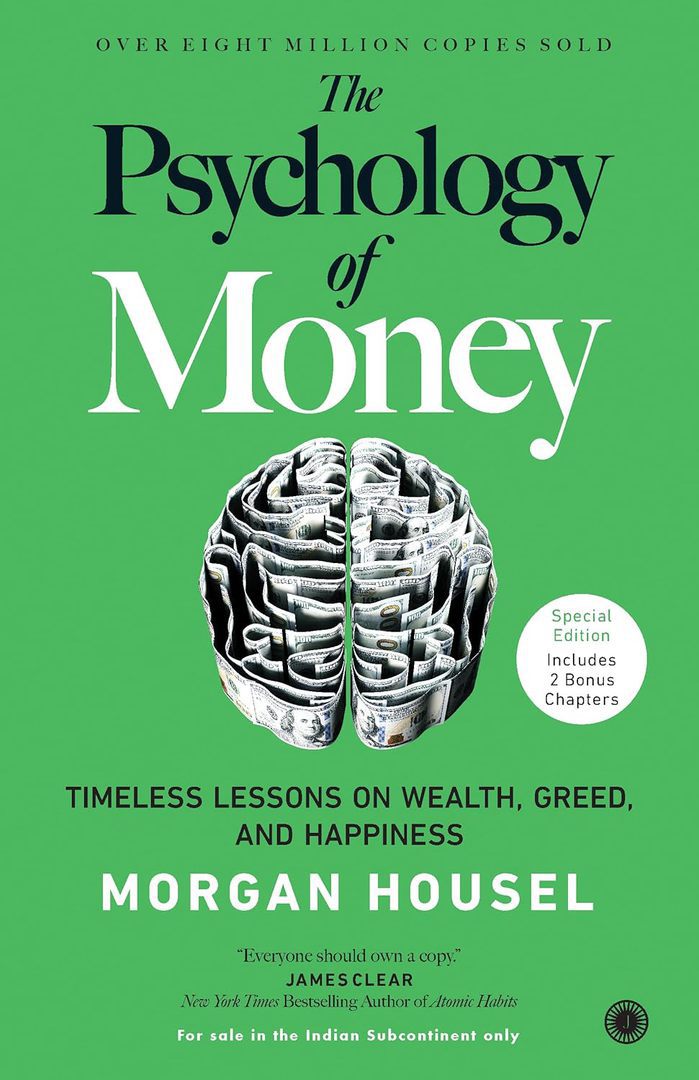
The Psychology of Money by Morgan Housel (houz-el)
Published 2020
Just looking at the title of the book seems intimidating as the science of money can be hard to comprehend. But the book is a book of short stories. There are 19 simple stories about real people and how they managed to become wealthy and there are stories of the extremely wealthy who lost all their money. Each chapter can be read separately even though all of them are centred on the same theme, the behaviour of people when dealing with their money. The author shows us how to manage our money. He says that we don’t need knowledge of accounting and finance to be successful with money. What we need instead is control over our behaviour and thinking. The key to building wealth is in saving over a long period of time and maybe even throughout your life till the very end.
Each story is about someone who is unique in the way that they have handled their money. They are the benchmark that help to teach us how we should handle our money in order to enjoy a safe and enjoyable life. He says that we don’t need to have the ability to make complex mathematical calculations and use data, formulae and spreadsheets to design our own financial maps that guide our spending patterns. Financial decisions are made by most people in their homes, sitting on a couch. It is here, that their unique view of the world, that has been formed due to the influences that have fallen on them, governs the way in which they deal with their money.
‘Doing well with money has a lot to do with how you behave.’ The introductory story is about the American janitor, Ronald James Read, who swept floors at JCPenny, and died a millionaire and philanthropist. He became wealthy simply on tiny savings compounded over time. You can have the best education, best training and the best connections in the world and yet have to file for bankruptcy if you don’t control your spending and always ‘spend money to show people how much money you have’.
People are born into different economies, job markets, countries and families. Each generation carries its own value systems. So, even though someone may seem crazy about what they are doing with their money, they are actually acting as a result of multiple influences on them. No one is crazy. There is a myriad of influences on us all
which influence our behaviour on the one hand. On the other outcomes in life are not only individual effort but is guided by forces not in the individual’s control. No one can predict or understand the role of luck in successful outcomes of investments. Not even respected economists. Attributing success to luck is, of course, not acceptable to anyone in our type of socially established norms and values. The line between ‘inspiringly bold’ and ‘foolishly reckless’ can be a millimeter thick and often visible only on hindsight. Many wildly successful investors were known to cleverly circumventing the law which most of us would be loath to do.
Even though money was created in Turkey in 600 BCE people did not save or invest their money till recently. These sciences are in their infancy. Retirement, itself is a new concept. Before World War II people worked until they died. Thus, we are all newbies at investing, saving and having a dignified retirement. This is why most of us are not sure about what we should do with our money.
Rich people do crazy things that make them vulnerable to losing the fortunes that they have made. The best chapter in this book is about the word ‘enough’. The author uses the story of Rajat Gupta, the Kolkata orphan who went onto becoming the CEO of McKinsey, the world’s most prestigious consulting firm. He became one of the most successful businessmen alive after his retirement. He had enormous wealth. But he hadn’t heard of this word, ‘enough’. From being a millionaire he wanted to graduate to being a billionaire. In 2008, while on the board of Goldman Sachs, he leaked information about Warren Buffet’s large investment in the bank initiating the buying of shares by an associate in the crime. He served prison time for this. On the other hand, Warren Buffet’s $84.5 billion net worth came after his 65th birthday. He was a phenomenal investor and started investing when he was only ten years old. He had the wisdom and patience to wait it out. Not that one has to become wealthy this way. There are other successful smart and quick investors too. In the last chapter the author talks about what he does with his own money.
Getting wealthy is sometimes easy but staying wealthy requires a different set of skills and mental makeup. One wants to become wealthy to be able to control one’s time and lead a life that makes one happy doing what one wants to do. You need to gauge the price you will have to pay for success and you must be prepared to pay it. Find out the price. Find out your own game and proceed accordingly. Don’t try to play anyone else’s game. The best benefit of money, is the independence and freedom that comes with it — to be able to control your own time.
The book is 238 pages and is very easy reading. The aim of the book, ‘The Psychology of Money’ is to teach us, by using short stories about real people, that the intelligent use of money is much more important than the math and formulas that may guide us on how to use our money. Being successful with money requires knowledge of psychology rather than that of finance. This book will teach you not only about finance but will enlighten you about human behaviour. It is about good human behaviour and teaches about the things that were taught to most of us during our childhood. This book is a ready reckoner and should be read periodically to keep oneself on the right track to increase one’s money and to prevent one from losing it. It is an international bestseller having sold 7 million copies worldwide. ‘Everyone should own a copy’ – James Clear.
Morgan Housel, the author of ‘The Psychology of Money’ is a former columnist of The Wall Street Journal. He is a distinguished member of financial journalism having won several awards. ’Wealth is the money you don’t spend’, he says.
Maybe more people reading such books will help to change human financial behaviour leading to a more stable world economic order. If you want to understand how to make money work for you, then you must read this book.
Turning Leaves 13
Heart Lamp by Banu Mushtaq
Published 2025
The International Booker Prize 2025
This book is a collection of short stories. The stories were originally written in Kannada, a language spoken by the people of the southern state of Karnataka, India. It has been translated by Deepa Bhasti and she shares the Booker Prize with the author, Banu Mushtaq. The author has been writing since the 1970s. She has six short story collections among other literary genres. She has won the Karnataka Sahitya Academy award. She writes about Muslim women and girls and about the Muslim social and family structure in South India. She has faced censure from conservative quarters in India but she continues to raise her voice against religious and social oppression of women. Her writing is classical, of high quality and of reference quality for historical significance of women’s lives in India in modern times. Ms. Mushtaq is an activist, journalist and lawyer.
Deepa Bhasti is the winner of The English PEN Translates award 2024. She has shared The International Booker Prize, 2025 with the author of this book, “Heart Lamp”. Deepa Bhasti, the literary translator has made the stories easy reading in English. The translation is not rigid and jarring. She has done responsible and sensitive translation not confining the stories to mere religious and cultural identities of a certain community but bringing out the universality of the stories. “..sisterhood...is the cushion I place my translation on,” she says. She has retained the hyperbole and special expressions of Kannada daily speech leading to the naturalness of the stories. Conventional salutations that establish Indian relationships have not been translated into their English versions thus keeping intact the Indianness of socio-cultural traditions and structure of the stories. Some north Indian words which are also common to the south have been transliterated to their Kannada version to make their pronunciation more realistic. No words in italics have been used which is conventional practice when using local words. This has been done in order to not distract the reader visually while reading the book and thus keeping the flow of reading intact. There are no footnotes. Ms. Bhasti has written a detailed note at the end of the book to explain her translation techniques.
There are a dozen stories in this book. All the stories have been previously published in Kannada. They have been published for the first time in English in 2025 going on to win The International Booker Prize, 2025. The first story, Shaista Mahal is about the intense love between Iftikhar and Shaista who share six children with the seventh on the way. Iftikhar wants to build a mahal that will put the Taj Mahal to shame to show his love for his beautiful wife. However, his wife dies and like elbow pain she is forgotten and he marries an eighteen-year-old within forty days of her death. The Quran states that girls of the family are entitled to their share of the property of their parents. “If the one who has rights is displeased, a rain of fire will fall.” Fire Rain is about the mutawalli Saheb and his sister Jameela. She dares to ask for her share of the properties and even threatens to go to court. Never let a daughter eave your home displeased for the story ends with the mutawalli Saheb’s young son developing meningitis.
The title story, ‘Heart Lamp’, is about Mehrun whose heart burned a lamp for her husband, Inayat and she was the lamp that lit up his heart till he left her for another younger woman. “The heart in Mehrun’s heart had been extinguished forever”. But she decided to live on, after attempting suicide, for her many young children who needed her. Even more dramatic is the last story in the book, ‘Be a woman once, O Lord!’ Written in first person with a strong pen and innovative grammar, the author has woven a story of a husband who throws his wife and children out and takes another wife, as he is entitled not only to take another but up to four wives, if he so wishes!
Wish there were more such books so that we, who are not a part of the Muslim community, could know more about them. We are keen to know. Knowledge of another community can drive away the fears and prejudices that are so common. Knowing the social norms and practices of different communities is important in fostering understanding and acceptance of them. There is always some good that can be learned, adopted and incorporated into one’s own community from them. Books such as this one can break barriers separating communities and bring about communal harmony stemming from understanding.
Turning Leaves 12
A picture book on National Parks and Wildlife Sanctuaries of India
Presented by State Bank of India – the banker to every Indian
Believing in yourself is the first secret to success
This book is about the richly preserved sanctuaries and national parks across India. The book has beautiful photos as it is a coffee table book. Coffee table books are always good keepsakes and one should make a collection of them. This one is a collector’s item for those who love nature and wildlife. It may not be possible to see each and every national park in India but one can enjoy them through such high-quality picture books.
The book covers fourteen national parks in the north, south, east, west and central India from Kaziranga to Corbett, Sudarbans, Ranthambor, Bharatpur and Kanha among others. Some of the parks have forts in them which belonged to the royal family of the region. Garumara has an ancient village in it which have villagers living there even today. These dense forests have wildlife, both fauna and flora in them.
These wildlife sanctuaries are well-maintained and protected by various government agencies. There are organized tours conducted by qualified and knowledgeable wildlife experts. They also know their way around the forest. Most parks have leopards, deer, elephants and peacocks in plenty. To see the Asiatic lion, Royal Bengal tiger, one-horned rhinoceros, blue sheep, musk deer, snow leopard and flamingos one has to go to specific forests or national parks.
The best season to visit is between November and April when the weather is cooler in India and the animals roam freely in the forest. There are convenient flights and trains to towns or cities near the park. From there one would have to hire a licensed vehicle to enter the forest. It is advisable to reach the parks before sunset as vehicles are not allowed within the park premises after dark. During the monsoons, June to October, many parks remain closed so do check this out before making your plans and bookings.
Details of some national parks: Sundarbans contains the world’s largest mangrove forests. It is home to the Royal Bengal Tiger that has acclimatized itself to the waters surrounding it by becoming an expert swimmer and leads an almost amphibian life. There is an exotic variety of birds and snakes here and the largest estuarine crocodile in the world. Gir forest has lions, the rare Asiatic one. Ranthambore Tiger Reserve has a large population of tigers and is renowned for tiger sightings, especially in the early morning. The Gangotri National Park is different as it is situated at a high altitude. It is large and is the home to the snow leopard, blue sheep and musk deer. The brown bear is an easy sighting. The Gaumukh glacier from which the river Ganga has originated is situated in this park. To see endemic wild flowers one can go to the valley of the flowers in Uttarakhand or to the Kaas Plateau Reserved Forest in Maharashtra where a plethora of flowers bloom from August to October.
Turning Leaves 11
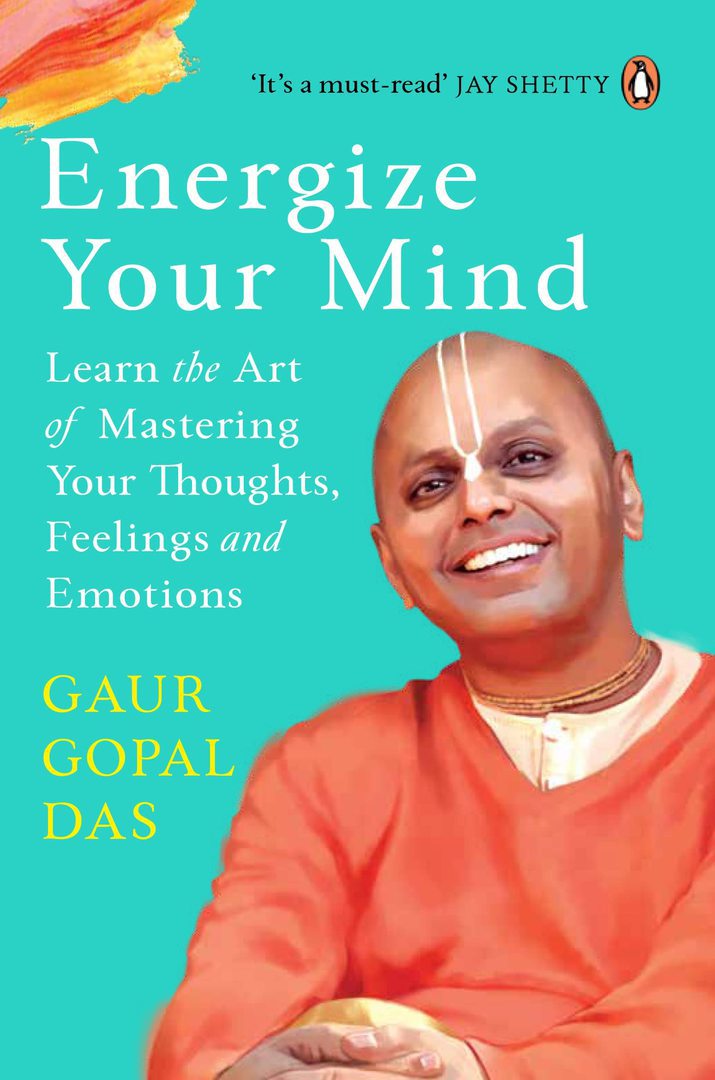
Energize Your Mind by Gaur Gopal Das
Published 2023
Controlling our minds is what all of us should be doing in order to lead a life devoid of debilitating worries and anxieties. We should learn how the mind works in order to be able to control it. Our minds should not control us. This book tells us how we can deal with anxiety and depression. It tells us how we can deal with and control our emotions. The minds of others affect us too. Thus, dealing with the toxic behavior of others have also been dealt with here. “If we strengthen the state of our minds then the external influences on it will seem less devastating”, says Gaur Gopal Das. He elaborates on how we can do this in his book, ‘Energize Your Mind’.
The book is the size of a normal novel. It has been divided into four sections. The first section is about your mind that details how to deal with depression, anxiety and with mental chatter. The next two sections deal with others’ minds and their effect on you. Dealing with toxic behaviour, old memories, criticism and grief have been outlined. We are shown how to develop empathy, communication and selflessness in order to deal with the minds of others. It is not only others that affect us but the universe does too. We are a universe within a universe. We are made of several layers of consciousness. We need to understand and deal with all of them. We must balance these different sheaths or ‘koshas’. We must identify each of our sheaths in order to know ourselves. Find your real self by energizing your mind through the methods outlined in the book. ‘Knowing yourself is the beginning of all wisdom’ – Aristotle.
There are innumerable exercises in the book for you to do in order to energize your mind. There are references that you can check out to help you to strengthen your mind. Each chapter ends with a short summary so you can use the book as a handy reckoner. The writing is interesting and easy to read. As expected, there are some Hindu philosophical explanations too, which the author has tried to underplay in order to keep the universal appeal of the contents.
The author, Gaur Gopal Das is not only a monk who has taken the vows of celibacy. He is also a well-known and immensely popular life coach whose goal is to help people to lead happy and fulfilled lives. “I believe this journey starts by energizing the mind,” says the author. He is widely travelled and loves meeting people. This book reveals how human he is even though he lives the life of a monk. This revelation of humanness makes his methods of energizing the mind more plausible and doable.
The book is really easy to read and understand. The exercises to strengthen the mind can be incorporated into our daily lives with little effort. Reading the book will also help us understand the people and world around us. This will help us to adjust better with our surroundings and with the people that we interact with. If we can be in harmony with everything around us it will energize us to lead happy and fulfilled lives.
“Take charge of your mind. Be in charge of your life.” – Gaur Gopal Das.
Turning Leaves 10
Orbital by Samantha Harvey
Published 2023
Booker Prize 2024
The book is about six astronauts rotating in their spacecraft above the earth. They are collecting data and conducting scientific experiments. Most of all, they are witnessing the spectacular beauty of the different parts of the earth from space. The astronauts are from six different countries, Russia, Japan, Italy and of course, the UK and US. It details the daily routine of astronauts in space. The astronauts are packed into the tiny space of the space station like sardines. They have to live like this for nine months before they can return to earth. The weightless drifting makes their bones less dense and their limbs become thinner. “They hang in their sleeping bags. Their sleep begins to thin”. However, they are privileged to witness the unique vastness and emptiness of black space. The book contains details of the geography of the earth as seen by the astronauts as they circle the earth constantly. There is a lot of geography in the book. “__distinctive northerly point of Oman jutting into the Persian Gulf, dust clouds over the navy Arabian Sea __coast of Malaysia dotted starlike in the black ocean___”
Though the novel is set in outer space there is no fantasy in the plot. The depiction of the life of astronauts is realistic. The astronauts have to keep reminding themselves that, ‘This is the morning of a new day’, as they see sixteen sunrises and sixteen sunsets while they orbit over the earth witnessing sixteen days and sixteen nights during the course of what is a normal earth day. There is no notion of days as morning arrives every ninety minutes. Roman thinks about his wife and home. Chie loses her mother while in space, ‘Without the planet there is no life’, they feel. They miss their families. They think of their lives back on earth. They understand how important the earth is to their lives. Mother Earth is “__Their towering parent ever-present through the dome of glass”.
Ms. Harvey is a teacher of Creative Writing in the United Kingdom. She has written novels and a book of non-fiction. She began the book five years ago but had shelved it. Later, she decided to finish it and it went on to win the 2024 Booker Prize. This prize was instituted in 1969 to recognize and honor authors whose works are written in English and are published in the UK. The Booker is one of the richest literary prizes. The award is given to a full-length novel. This book is more like a novella of only 136 pages. It is largely descriptive with virtually no plot except for the daily routine of the astronauts within the space station and their regular routine walks into outer space. After all, other than this there isn’t much else one can do in a space station.
The book is rather repetitive describing the orbits of the spacecraft over and over again. It has no plot, action, climax or resolution. It is more of a novella rather than a novel.
Turning Leaves 9
<<
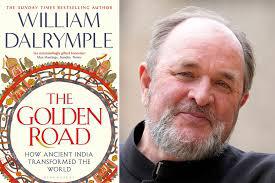
The Golden Road by William Dalrymple
Published 2024
How ancient India transformed the world
This book is about ancient India, both before common era and common era till the 12th and 13th centuries. It is about trade between India and the Roman Empire and between India and the countries to the east of it. According to the author, these trade routes between India and the countries to the west and east of it were more important and came much earlier than the ‘Silk Road’ that is more well known in our contemporary world. Not a single ancient record refers to a ‘Silk Road’. This book has documented the ‘Golden Road’ which was the main trade route in the ancient world. Roman gold and silver coins, in their tens of thousands, have been found by archaeologists in India proving that there was extensive trade between India and Rome. Silk was never the main commodity imported to the west from the east. It was Indian pepper, spices, ivory, cotton, gems, teak, sandalwood and rhubarb that were in demand and were imported into the Roman Empire at astronomical prices.
The book contains details of the Ajanta murals, in their brilliant colors, that show thestory of Buddha who lived in the fifth century BCE. There are murals showing the rich ife of the people at that time. Alexander the Great arrived in Punjab in fourth century BCE. He and his soldiers were influenced by Buddhist ideals and carried these back when they left India. Chandragupta Maurya, his son Bindusara and most of all, his grandson, Ashoka helped spread Buddhism beyond the boundaries of India. He established ‘dharma’ / moral duty in his vast kingdom and in Pataliputra, his capital, which was probably the largest city in the world. He taught that the animal and natural world are closely related to humankind. India moved on to become the ‘sink of the world’s most precious metals’. In Berenike, on the Red Sea, has been found prototypes of Hindu Gods and Sanskrit inscriptions of the 3rd century. There have been Indian finds like gems, pearls, teak from Kerala, bones and skulls of elephants and monkeys. It was through these ports of the Red Sea that trade was established between India and the Roman Empire. Indian sailors on the east coast of India were trading with South-East Asia by second century BCE. India had a strong shipbuilding tradition. Travel by sea using the winds was quick and easy rather than travel by land which was slow and fraught with dangers. Read about the Nalanda University with its treasured library, the Kushan empire of Afghanistan and the spread of Indian ideas into Central Asia, the Buddhist conquest of China made possible by the fifth concubine, who would become the first female Emperor Wu Zetian, the contributions of the Pallava dynasty and their capital, Kanchipuram and their scholarly reputation second only to Nalanda and the rise of Hinduism. They opened up trade routes to China and the South-East. The eastward monsoons carried the huge cargo ships tothe east as did the westward monsoon winds to the west. The Brahmi script appears n South-Eastern inscriptions. By the fifth century, Hindu religion influenced the Southeast. The eastern branch of the Golden Road was firmly established. The adventuresof Vajrabodhi, the powerful tantric who could make rain, the great Empire of Angkor, The Khmer kings ruled over a prosperous part of the globe for several hundred yearswhich by the twelfth century was the richest country in the world. Indian Brahmins and Shiva ascetics started travelling with the traders to the South-east. Temples with inscriptions from the Ramayana and Mahabharata have been found. The science of numbers and ayurveda was imported by the Arabs and adapted to their needs. These were imported by Europe and to the English to set up accounting which developed their commerce which in turn helped them to conquer India in later years. History, ofalmost two thousand years has been traced in detail by the author in this book.
The book is about the ancient world and the lucrative trade that India had with the Roman Empire, making it one of the richest nations in the world. It was not only the trade in spices, ivory, metals and cotton but also the export of knowledge in mathematics, astronomy, astrology, physics, metaphysics and medicines. Later the trade of knowledge would find their way to the enlightened Arab world and from there to Europe to form the foundation of the modern sciences and mathematics. This trade route, the Golden Road stretched from the Red Sea, in the west, to the Pacific Ocean, in the east from 250 BC to 1200 AD to form the Indosphere of the ancient world. This is why today we see the influence of Indian art, music, dance, literature over half the world’s population. Ancient India ruled the world for nearly two thousand years. It was the East India Company that closed the dominance of Sanskrit-Persian coexistence and slowly English dragged India into the Anglosphere closing the Indosphere of the ancient world. Today, many believe that India’s dominance is slowly returning and India will, once again, find itself at the centre of the world, bridging east and west, as it had done in the ancient world. India represents cohabitation and not a clash of cultures. What will India be at the end of this century? Could it again be the agent for uniting the world, not by the sword but by the power of its ideas and the skills of its gentle people who are so well versed in mathematics and science?
Mr. Dalrymple is a skilled storyteller and an eminent historian. He has made ancient history easy and interesting to read. The book is filled with stories which are true and real and which reflect history. The ancient world is brought alive through innumerable well-researched references which have been meticulously listed at the end of the book. This book is a history book, an ancient history book, yet at the same time it is an interesting novel. The author is a veteran writer. His cousin is Virginia Woolf. He has many ancestors that were born, lived and died in Calcutta-now-Kolkata, the erstwhile capital of British India. He has a Bengali ancestor. Prinsep Ghat is named after his great uncle James Prinsep who unlocked the secrets of the scripts on the Ashoka Pillars of ancient India. He now lives in Delhi with his family. His wife is Olivia Fraser, who is an eminent painter who paints Indian miniatures. He is part of the British aristocracy, part of the landed gentry, both on his father’s and mother’s side. The writer has several prize-winning books to his credit. He has been awarded five honorary doctorates. He has co-founded the Jaipur Literature Festival, which is one of the pioneer literature gatherings of India. This eminent British historian lives on a farm outside Delhi now. Mr. Dalrymple must be credited with popularizing authenticated, documented and scholarly ancient history. It is always necessary to know ancient history in order to be in control of one’s own destiny through knowledge and wisdom.
On first appearances the book looks thick, heavy and daunting. But the actual text is the length of an average novel. It is 298 pages long. The rest 184 pages are compiled into extensive notes, bibliography, glossary, index and image credits. (The note on the type used for the text of the book makes for very interesting reading.) This page measure shows how well-documented is the text of the book. The 298 pages have been divided into ten chapters. Each chapter can be finished in an hour and one can finish the book in ten days without disrupting one’s daily schedule. One’s perspective of the Indian subcontinent, Central Asia, the Arab world, China and the Far East will be transformed forever after reading this book.
Turning Leaves 8

The Instrumentalist by Harriet Constable
Published 2024
A book for all those who love western classical music
The book is about the composer, Vivaldi, the creator of the most popular piece of western classical music, The Four Seasons. This is a debut novel. The author, Harriet Constable, is a filmmaker and award-winning journalist, living in London. It is about Venice of the early 18th century, when the city was prosperous enjoying centuries of economic and political stability thus allowing the nobility to cultivate the creative arts. It is about Anna Maria della Pietà, the greatest violinist of the 18th century, who was an abandoned newborn foundling, left by her harlot mother at the Orphanage della Pietà run by nuns. Anna Maria is exceptionally talented being acknowledged as a child prodigy, who becomes the Master of Music at the tender age of seventeen. Her teacher is Vivaldi, who assists her in her climb to being the much-loved musician of Venice who is able to transport her listeners to dizzying heights of joy and excitement during her performances at palaces and grand residences. Her teacher drops her, as men were privileged to do, in those days, as she began to outshine him at public performances. There are graphic descriptions of her wanderings in the city, lost among the dark underbelly of it, till she is rescued and returned to the Pietà.
The author has researched Anna Maria. There is evidence to show that she was indeed a maestro at a tender age and was made the Master of Music at the Pietà, succeeding Vivaldi. However, there is little information about her and none of her compositions have survived. She composed extraordinary music which Vivaldi acknowledged as his own. Most probably, a considerable part of the Four Seasons was composed by her and others at the Pietà. Vivaldi spent most of his career at the Pietà and scholars agree that without the orchestra of the Pietà his music would not exist today. Many of his compositions were presented to Venetian society at the Pietà. He was a brilliant but difficult man who was destined to die alone and penniless in Vienna, another top music center of the time.
The characters have been beautifully crafted and the conflicts richly dramatized. The environment of 18th century Venice has been established very well with details of the rooms, the food, the clothes and the daily routine chores of the community of the Pietà being described in detail. The streets and canals of Venice, the Basilica San Marco, the Rialto market, the lagoons and islands have all helped to make the setting of the story real and vibrant. However, the author has not stuck to precise historical facts and dates. She has used her imagination to weave her story not allowing the book to become a biography but rather a work of fiction outlining the fact that a collection of female inmates of an orphanage in Venice are the true composers of the most famous work of classical music, The Four Seasons, Anna Maria della Pietà being the principal composer among them.
Turning Leaves 7
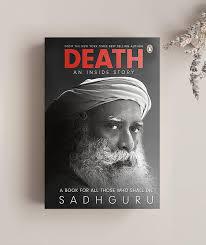
Death by Sadhgur
Published 2020
A book for all those who shall die
That death is not a calamity nor a catastrophe but an essential aspect of life is what this book is about. There are the pancha pranas, the five vital energies that exit through the chakras, the 112 energy channels in the body and two outside the body which have been simplified into the seven chakras. Details are given as to what you will become in your next life if you exit through a particular chakra. Prarabdha karma is something we all need to work out as this determines when we can drop the body in a timely manner. Finishing your prarabdha karma will lead to an early death and taking too long to complete your prarabdha karma can lead to your body becoming too frail to be able to complete it.
Why is it so important to complete your karma and to exit your body through a particular more desirable energy channel? The objective is to not be embodied again and again but to be exempted from rebirth. Mukti is easy if we know what to do. We need to be aware of death and to work towards designing a successful one. It is difficult to design a successful life without any upheavals and pain but it is relatively easy to design a good death in mahasamadhi. This is not only a condition that can be attained by holy men but can be done by all of us. We have to understand the nature of death and work towards completing the process properly.
Moving from the physical to the non-physical state is the greatest moment of your life. To make this moment wonderful you must live your life well. Living well does not mean acquiring success and material belongings but to have inner bliss devoid of conflict. If you have lived well, you will be able to exit your body in full consciousness, which is the most desirable way to drop your body in order to obtain moksha. Don’t be fearful. Master the ways of life. Sit quietly and die. Don’t make family drama.
Those who have lived their life ‘stupidly’ will also be liberated if they are able to live through 1008 full moons. This translates to 84+ years. This is why living a long life is important. Most of us live spiritually purposeless lives with immature consciousness of doing karma. Be aware in death by leading a life of awareness. Practice of Shoonya meditation and to a lesser extent Isha Kriya can make you maintain awareness through the transition process. You need to generate ojas. These are non-physical forces generated by spiritual practices. These will help you in death and will make your movement through life easy too.
Sadhguru is the living proof that there is rebirth and an afterlife. He has been through several lives and there is proof of this. He has established the Isha Foundation and the Isha Yoga Center which has 300 centers worldwide with 9 million volunteers. He has wide interests at all levels. He has written several books to help in empowering individuals. Isha has a unique approach in cultivating human potential. The Isha Yoga Centre is at the base of the Velliangiri Mountains, near Coimbatore, in Southern India. Information about it can be found at isha.sadhguru.org. He doesn’t interfere with your life but he holds your death in his hands and can design it for you.
This book is not for the young nor for the middle-aged. This book is for those who are completing their life cycle and for those who are on the threshold of transition. For those who are moving from the embodied to the disembodied state it is useful to know about the mechanism of the transition so that one can move to the disembodied state correctly in order to make the bubble of rebirth burst.
Turning Leaves 6

Spare by Prince Harry
Memoir of a Senior British Royal
The book that the whole world was waiting to read. The book that has sold a “record” 1.4 million copies in just 24 hours and has sold more than 3.2 million copies worldwide after just one week of publication. Prince Harry's “Spare” memoir will likely rank among the bestselling memoirs of all time, they say. I would agree with that. The book has been beautifully crafted. The 416 pages is interesting and available in digital, paperback, and hardcover formats and has been translated into fifteen languages. There is also a 15-hour audiobook edition, which Prince Harry narrates himself.
If you want to get voyeuristic pleasure looking into the strife and conflicts of the British Royal Family, a family that is a thousand years old, in which sibling rivalry and familial favoritism seems to be just as vicious as in any other common family then this book is for you. If you want to read about a young prince who lost a much beloved mother at the tender age of twelve and thus remained traumatized into his adulthood this book is for you. This book is about a sensitive young man with the best of intentions to do good but who is prevented from doing so because of intense and absurdly hostile negative press who literally ‘pick’ on him to make their fortunes. However, should a high-born prince be so sensitive like us commoners? Shouldn’t he be immune to the ever-vigilant and persistent press? To leave his own much-loved country, family and friends because of intrusive members of the press seems rather a far-fetched reason for taking such a life-changing decision.
The book opens with the dramatic death of his beloved mother and the tough times the prince went through to adjust to the void left in his life. Part 2 is about his military training programs, actual duties in combat zones and his travels to the North and South Poles. The third and last part is, of course, you’ve guessed it, his courtship, marriage and settling down in California. There are candid descriptions of many things private but that is the nature of modern biographies and memoirs. The book is hugely honest and outspoken but tilts often to ‘oversharing’. Each of the three parts, is written in short numbered sequences making for easy and interesting reading. But what I liked the most is that one gets to read first-hand the Queen’s English! And, to realize that the English that we use, both written and spoken, is exactly the same! How thrilling that was!
But all said and done, one finishes reading the book feeling sympathy for a sweet, well-meaning prince, relegated to leading the life of an exile in a faraway land away from his father and brother.
Turning Leaves 5
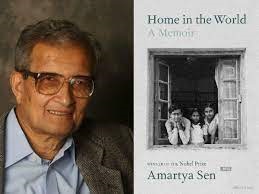
Home in the world by Amartya Sen
Published: 2021
Publisher: Penguin Random House
Pages: 395
Memoir of the 1998 Nobel Prize Winner for Economics
This memoir is, of course, first and foremost, full of economics. It is a first-hand account of actual happenings in the academic world of economics during the fifties into the seventies of the last century. The author, Amartya Sen, outlines his life, beginning with his early years spent in Mandalay in Burma, then Dacca, finally settling into school without walls in Santiniketan, West Bengal in India. He mentions how he was influenced by his scholar grandfather and the Tagorean philosophy andsystem of education. He attends college in Calcutta graduating to study further at Trinity College, Cambridge. He returns back to India to teach at Jadavpur University. Later, he teaches at D-School at Delhi, the capital of India. The book is about a distinguished journey by a brilliant scholar and thinker who has more than one home in this world and is comfortable in all his diverse homes.
This book is for economists. There are many references to well-known economists of the mid-20th century and their work. Books are referred to which will make for further reading, both for economists and for readers like us, who know no economics. This book is for Bengalis, the people of the state of West Bengal, India and the people of Bangladesh. There is a lot of history which they would find interesting. The Rivers of Bengal and The Urbanity of Calcutta are particularly interesting to read. Sen has spoken eloquently on them. The ancient remains found scattered around the general Calcutta region indicates why the British founded the city in the place where they did. And, if you happen to be a Vaidya then you definitely need to read this book written by the most globally honored Vaidya of all.
Amartya Sen comes from a family of professors and scholars. He says that he was more comfortable in expressing himself in Bengali and Sanskrit till he mastered English. So, he proves that it is more important to be a good student of a language rather than to be a ‘native speaker’ of it. The book is most eloquently written. The style is simple and easy to read. The tone is friendly and young. One can go through the almost 400 pages quickly and easily.
This is a truly global book. For world citizens this book is a must read, not only for knowing about economics from a Nobel Prize winner but for knowing about Bengal and about British India. The book ends rather abruptly. We hope that that means there will be a sequel soon.
https://www.goodreads.com/review/show/4562473120
 Print
Print